Why It’s Silently Limiting Your Organization’s Performance
How often do you or your team feel:- Things are getting worse.
- I’m losing control.
- I can’t predict what’s going to happen next.
For many leaders and employees, the answer is: more often than we admit.
Research shows that over two-thirds of employees report being stressed at work. And stress isn’t just a personal issue — it’s a performance issue.
You may believe your biggest challenge is AI adoption, productivity gaps, or aggressive competition.
But your biggest constraint is closer to home.
It’s stress.
Stress Is Not “Too Much To Do”
Stress is a biological response triggered by how we experience our environment.
There are three primary types of stressors:
- Physical stress — trauma, injury, illness
- Chemical stress — toxins, pollutants, viruses
- Emotional stress — deadlines, financial pressure, conflict, uncertainty
In today’s workplace, emotional stress dominates.
And three perceptions trigger it:
- Things are getting worse
- I’m losing control
- I can’t predict the future
Sound familiar?
 The Neurology of Stress
We think approximately 60,000–70,000 thoughts per day. Research suggests that 90–95% of those thoughts are the same as yesterday’s.
If yesterday was stressful, today will likely be the same.
Thoughts trigger chemistry. That chemistry signals the body. The body then reinforces the emotional state.
When the stress response activates, the autonomic nervous system shifts into survival mode:
- Heart rate increases
- Breathing accelerates
- Digestion slows
- Blood flow shifts to the extremities
- The body prepares to fight, run, or hide
This response was designed for short-term danger.
But when activated repeatedly — emails, deadlines, uncertainty, performance pressure —the body begins to live in survival mode.
What was once adaptive becomes maladaptive.
Over time, stress chemistry narrows thinking, reduces creativity, and increases reactivity.
People become more:
- Defensive
- Competitive
- Self-protective
- Less collaborative
Collaboration is the foundation of productivity.
Why Your Team Isn’t Producing More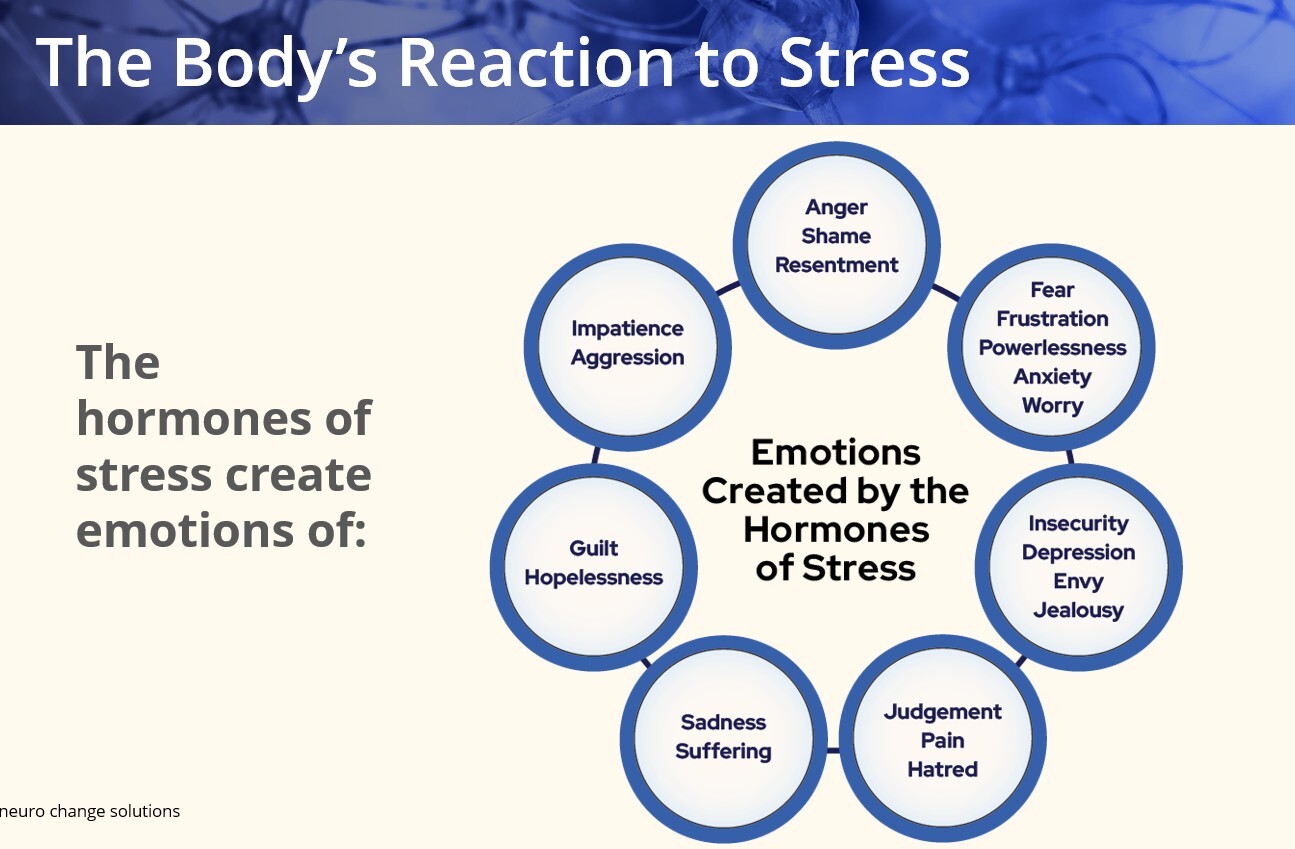
Most people don’t struggle because of capability.
They struggle because their thoughts, emotions, and behaviors are conditioned to repeat the same stress-driven patterns.
Stress creates:
- Short-term thinking
- Reduced innovation
- Slower decision-making
- Poorer communication
- Lower engagement
A stressed brain cannot create at its highest level.
If your team is living in survival mode, they cannot operate in creation mode.
 The Real Leadership Opportunity
Imagine a culture where:
- Leaders think clearly under pressure
- Teams regulate emotion before reacting
- Communication is direct and constructive
- People feel empowered instead of threatened
- Decisions accelerate instead of stalling
This begins with self-awareness.
When individuals learn to recognize stress patterns and regulate their internal state, productivity increases naturally.
Clarity improves.
Creativity expands.
Collaboration strengthens.
Change does not begin with systems.
It begins with thinking.
Creating Change That Scales
At Unbelievable Coach, we help leaders and organizations break the cycle of stress-driven performance and intentionally build envisioned futures —personally and professionally.
Using the neuroscience-based tools from Change Your Mind. Create New Results, teams learn how to:
- Reduce stress responses
- Increase emotional regulation
- Improve clarity under pressure
- Build cohesive, high-performing cultures
Change begins with individuals.
It scales through leadership.
And it transforms culture.
If you’re ready to move your organization from survival to creation:
Challenge yourself.
Challenge your team.
Challenge your business.
Curious how much stress is silently impacting your team?
Let’s measure it.
Schedule a brief strategy session and receive a customized leadership stress and performance assessment.
👉 Reserve your executive session here.
👉 Schedule a free exploratory conversation and begin creating your envisioned future.
Growth Demands Strategic Discipline.
If your team is operating in a constant state of stress, productivity will suffer — no matter how strong your strategy is.
The real question becomes:
How do you reduce stress without lowering standards?
How do you increase productivity without pushing harder?
The answer begins with understanding brainwaves.
In Change Your Mind. Create New Results, we explore four primary brainwave states — Beta, Alpha, Theta, and Delta — and how each one affects performance, creativity, and decision-making.
If you want greater focus, collaboration, and innovation in your workplace, you must help your team move out of high-stress brain states and into creative ones.
In the next blog, we break down exactly how these brainwave states work — and how leaders can intentionally shift them.
If you’re serious about elevating performance, this is where it begins.
 Building an enduring great organization requires disciplined people, disciplined thought, disciplined action, superior results, producing a distinctive impact on the world.
Discipline sustains momentum over a long period of time, laying the foundations for lasting endurance.
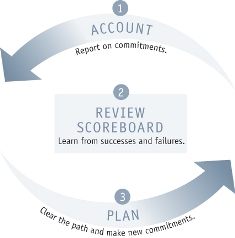
A winning habit starts with 3 Strategic Disciplines: Priority, Metrics, and Meeting Rhythms. Forecasting, accountability, individual, and team performance improve dramatically.
Meeting Rhythms achieves a disciplined focus on performance metrics to drive growth.
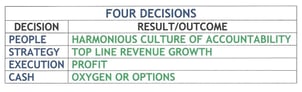
Let Positioning Systems help your business achieve these outcomes on the four most Important Decisions your business faces:
|
DECISION |
RESULT/OUTCOME |
|
PEOPLE |
|
|
STRATEGY |
|
|
EXECUTION |
|
|
CASH |
|
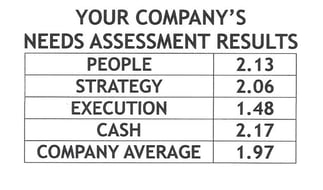
Positioning Systems helps mid-sized ($5M - $500M+) businesses Scale-UP. We align your business to focus on Your OneThing! Contact dwick@positioningsystems.com to Scale Up your business! Take our Four Decisions Needs Assessment to discover how your business measures against other Scaled Up companies. We’ll contact you.
NEXTBLOG – The Brainwave Shift That Unlocks Productivity



.jpeg?width=150&height=135&name=Hand%20with%20marker%20writing%20the%20question%20Whats%20Next_%20(1).jpeg "Schedule a meeting")