
Every leader has been here.
You’re in a meeting.Something goes wrong.
A deadline slips.
A mistake gets made.
And in that moment, you try to address it.
You explain.
You correct.
You push for change.
But instead of progress… You get resistance.
Defensiveness.
Silence.
Or worse — agreement with no follow-through.
And you walk away thinking:
“Why didn’t that land?”
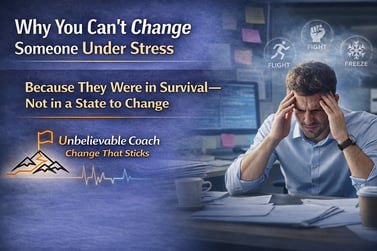
Because They Were in Survival—Not in a State to Change
 Here’s what most leaders miss:
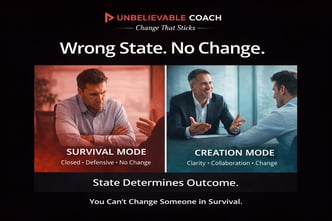
You cannot help someone change when they’re under stress.
Not because they’re unwilling.
Not because they don’t understand.
But because their brain is not in a state that allows change.
What Stress Actually Does to the Brain
When someone is in high beta brainwave states (stress), their system shifts into survival.
In that state:
- Trust drops
- Listening narrows
- Emotions heighten
- Thinking becomes reactive
- Perspective disappears
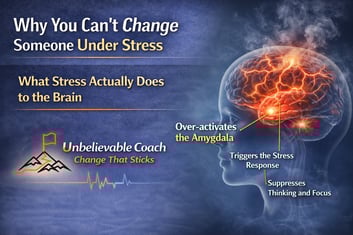 They are not processing your message the way you think they are.
They are filtering everything through one question:
“Am I safe?”
And when the brain is asking that question…
It is not open to change.
Why Leaders Keep Getting This Wrong
Most leaders assume:
“If I explain it clearly enough… they’ll get it.”
But here’s the truth:
Clarity doesn’t matter if the nervous system is dysregulated.
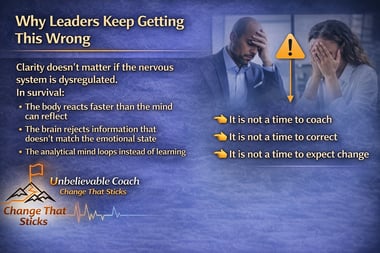 In survival:
- The body reacts faster than the mind can reflect
- The brain rejects information that doesn’t match the emotional state
- The analytical mind loops instead of learning
Which means:
👉 It is not a time to coach
👉 It is not a time to correct
👉 It is not a time to expect change
It is a time to recognize state.
The Leadership Skill No One Talks About
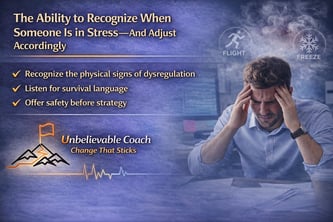 Great leaders develop something most never think about:
The ability to recognize when someone is in stress—and adjust accordingly.
You can see it:
- Tight tone
- Short responses
- Defensiveness
- Urgency
- Emotional reactions
In those moments, pushing harder makes it worse.
Because you’re trying to create change…
In a state where change is neurologically unavailable.
The Shift: From Survival to Creation
If change doesn’t happen in stress… where does it happen?
It happens in what we call creation mode.
This is when the brain shifts out of high beta and into slower, more coherent states:
- Mid and low beta (focused, stable thinking)
- Alpha (calm, open awareness)
- Even theta (deep internal change)
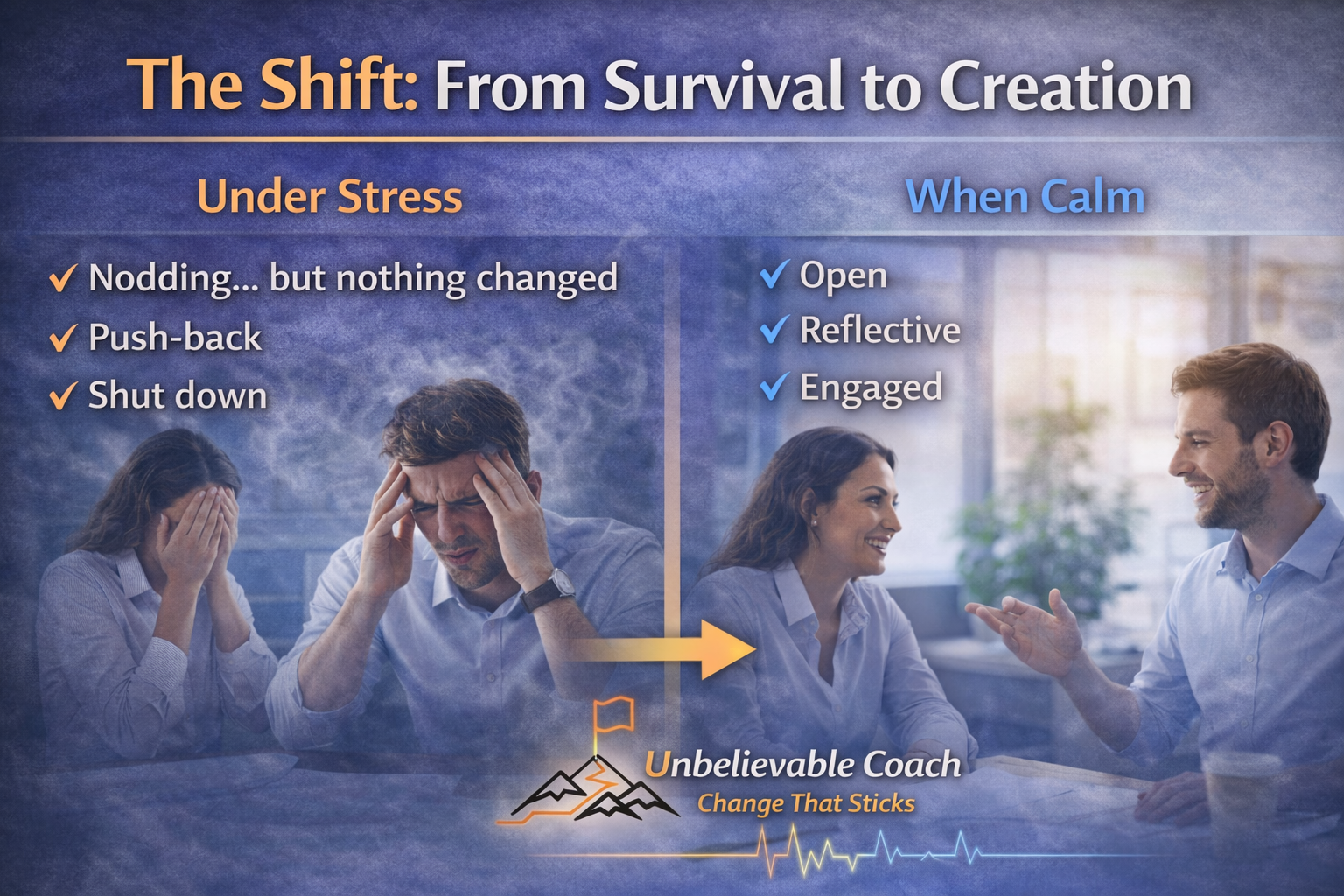
This is where:
- People can reflect instead of react
- Listen instead of defending
- Collaborate instead of protect
- Learn instead of resisting
This is where change becomes possible.
A Moment Every Leader Recognizes
Think about someone on your team who frustrates you.
Now think about the last time you tried to address it when they were already under pressure.
How did it go?
They nodded… but nothing changed.
Or they pushed back.
Or they shut down.
Now imagine the same conversation…
But when they’re calm.
Open.
Present.
Same message.
Completely different outcome.
 This Is Why Most Change Efforts Fail
Organizations try to improve:
Communication
Accountability
Performance
Culture
But they do it while people are under stress.
So the result?
- Conversations don’t land
- Training doesn’t stick
- Behavior doesn’t change
Because no one addressed the most important variable:
State.
What “Change Your Mind. Create New Results.” Actually Solves
This is exactly why Change Your Mind. Create New Results. can be life-changing for an organization.
Because it doesn’t just teach strategy or behavior.
It teaches people how to:
- Recognize stress states in themselves and others
- Stop trying to force change in survival mode
- Shift out of high beta into more coherent states
- Create conditions where real change can occur
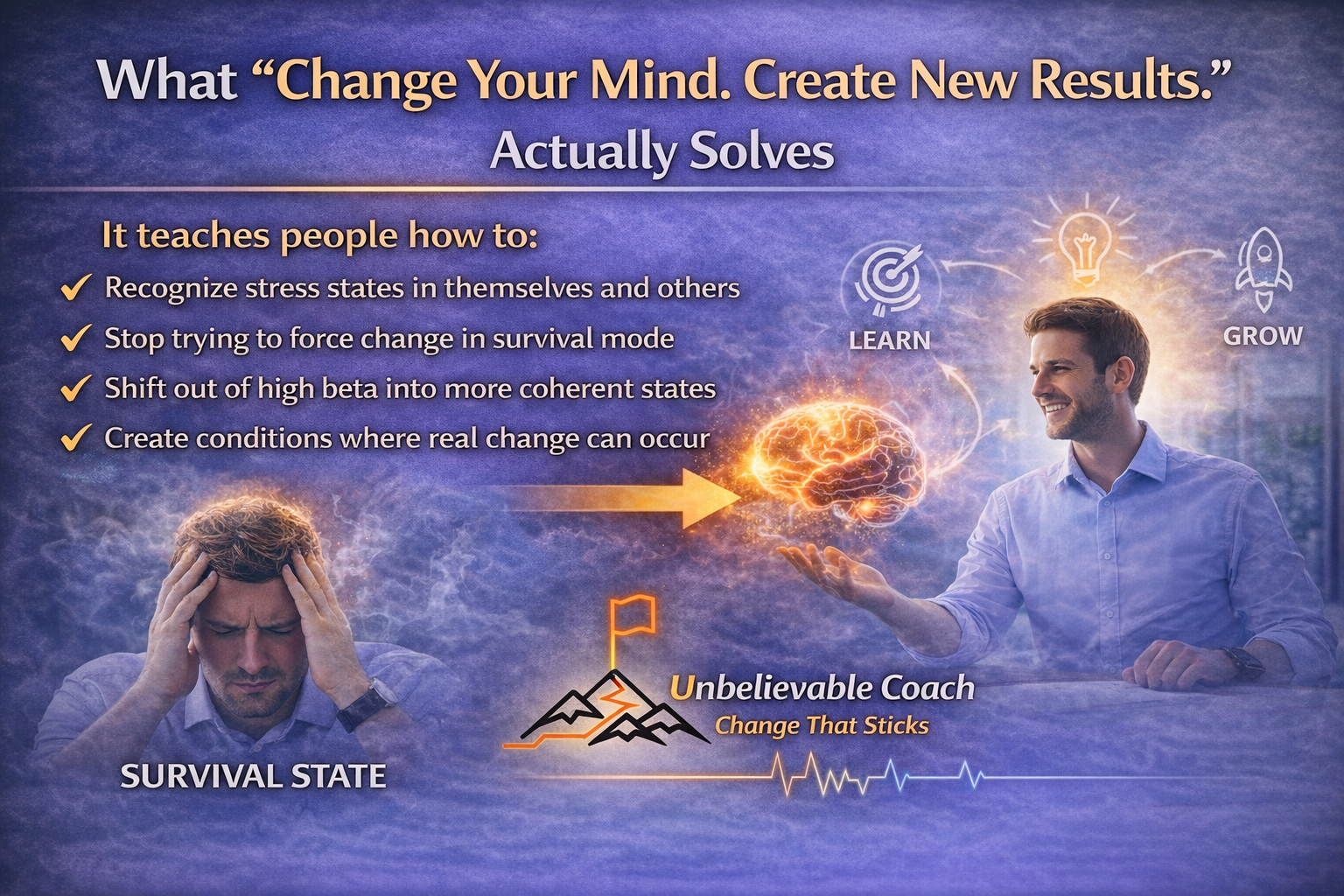
In other words:
It gives leaders and teams the ability to move from reaction to creation.
What Happens When This Becomes the Standard
When leaders and teams understand this…
 Everything changes:
- Communication becomes clearer
- Collaboration improves
- Creativity returns
- Conflict decreases
- Productivity rises
And most importantly:
People stop surviving the workday…
And start creating results intentionally.
Stop Trying to Change People in the Wrong State
If someone is under stress, they are not resisting you.
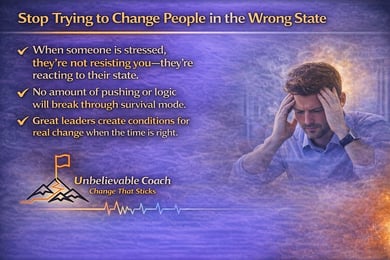 They are reacting from survival.
And no amount of logic, pressure, or explanation will override that state.
Great leaders understand this.
They don’t force change in the moment.
They create the conditions where change becomes possible.
Because real leadership isn’t about pushing harder.
It’s about knowing when change can actually occur — and when it can’t.
Growth Demands Strategic Discipline.
You can’t change someone under stress.
But here’s the real question:
If that’s true… what should a leader do instead?
That’s our next blog: If You Can’t Change Someone Under Stress… What Do Great Leaders Do Instead?
Most people don’t struggle because of capability — they struggle because their thoughts, emotions, and behaviors are neurologically conditioned to repeat the same results.
Capability isn’t the problem.
Conditioning is.
.png.jpg?width=481&height=514&name=Its%20not%20a%20Capability%20Problem%20(Tight).png.jpg)
When stress becomes the default state, even smart leaders end up repeating predictable outcomes. Change the pattern — change the result.
Through Change Your Mind. Create New Results training: I help leaders interrupt stress-driven conditioning, regulate under pressure, and build cultures driven by intention rather than reaction.
If you're ready to move from reactive productivity to intentional performance, let’s talk.
 Doug Wick, Unbelievable Coach
Change That Sticks
Schedule a Strategic Conversation
Change the Pattern. Create New Results.
NEXT BLOG: If You Can’t Change Someone Under Stress… What Do Great Leaders Do Instead?



.jpeg?width=150&height=135&name=Hand%20with%20marker%20writing%20the%20question%20Whats%20Next_%20(1).jpeg "Schedule a meeting")