
The Paradox of Breaking the Habit
In last week’s blog, we established a critical truth:.png?width=182&height=273&name=Why%20It%E2%80%99s%20So%20Hard%20to%20Change%20%E2%80%93%20The%20Paradox%20of%20Breaking%20the%20Habit%20(Preview%204-27-26%20blog).png) You can’t change someone when they’re under stress.
You can’t change someone when they’re under stress.
So now the real issue becomes:
Why is change so hard—even when people want it and are trying?
Most people assume it’s a discipline problem.
It’s not.
The hardest part of change…
is not doing what you did yesterday.
The Real Problem Isn’t Effort—It’s Awareness
People don’t repeat patterns because they decide to.
They repeat them because they don’t see them.
- The same reaction in a meeting
- The same tone under pressure
- The same decision pattern
- The same emotional response
 It feels automatic… because it is.
Research suggests we’re only about 5% consciously aware of what we think, do, and feel throughout the day.
That means:
95% of behavior—yours and your team’s—is running on autopilot.
So when a leader says,
“I know I should handle that differently…”
They’re not wrong.
But neither is their team when they say the same thing.
This Isn’t Just a Leadership Problem
It’s easy to look at behavior and assume it’s a leadership issue.
But the same pattern exists across the organization:
- Employees reacting instead of thinking
- Teams defaulting to familiar habits
- Conversations repeating the same dynamics
- Problems getting solved… the same way… over and over
Not because people don’t care.
Because they’re not aware in the moment, it matters.
So what shows up as a “people issue”…
Is almost always a pattern issue.
Why Knowing Doesn’t Translate Into Change
This is where most change efforts break down.
 Leaders and teams try to change through intention:
“We need better communication.”
“We need to stay calm under pressure.”
“We need to think more clearly.”
But intention requires awareness.
And under pressure?
Awareness drops.
Speed increases.
The pattern runs.
So the issue isn’t capability.
It’s that behavior happens before awareness catches up—at every level of the organization.
The Paradox of Change
To change, you have to do something different.
But to do something different…
You have to notice what you’re doing—while you’re doing it.
And most people don’t.
That’s the constraint.
Not knowledge.
Not motivation.
Awareness.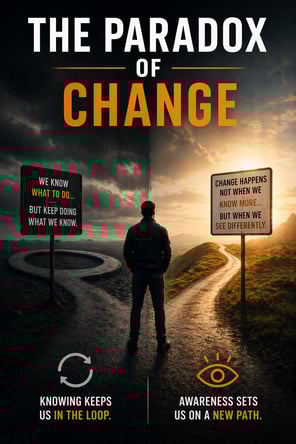
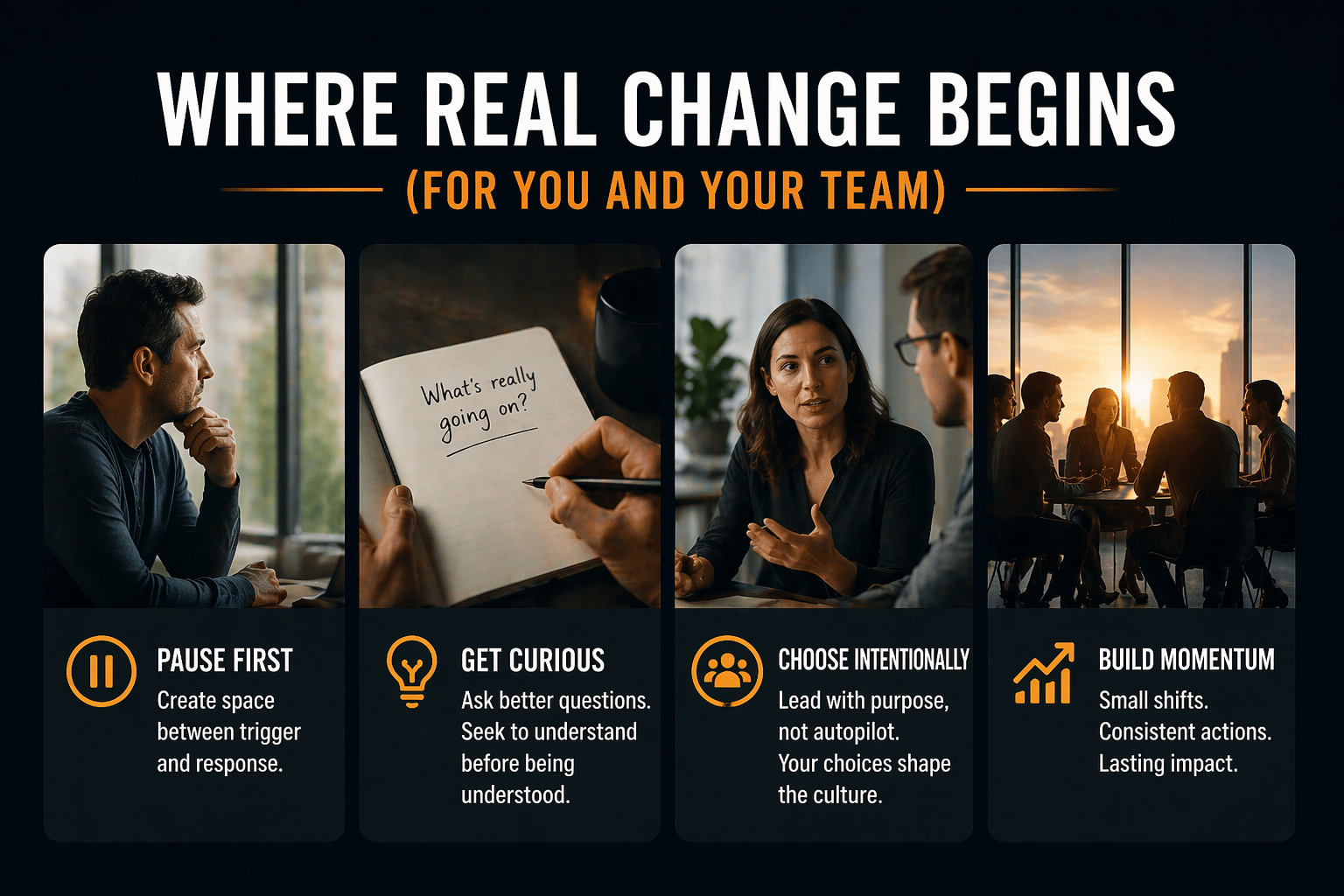
Where Real Change Begins (For You and Your Team)
Self-awareness isn’t reflection after the fact.
It’s recognition in real time.
- Catching the reaction as it starts
- Noticing tension before it drives behavior
- Hearing your tone as it shifts
- Recognizing the pattern mid-conversation
That’s where change begins.
Because once you see it…
You can interrupt it.
And once you interrupt it…
You can choose something different.
This Is the Work
This is exactly what Change Your Mind. Create New Results. is designed to do.
Not just help leaders understand change…
But help leaders and their teams:
- Increase real-time awareness
- Recognize conditioned patterns
- Interrupt automatic reactions
- And begin responding with intention instead of habit
 Because until that happens:
Training doesn’t stick.
Conversations don’t change.
And performance stays inconsistent.
The Leadership Standard
Leaders don’t just experience patterns.
They shape the environment where patterns either continue—or change.
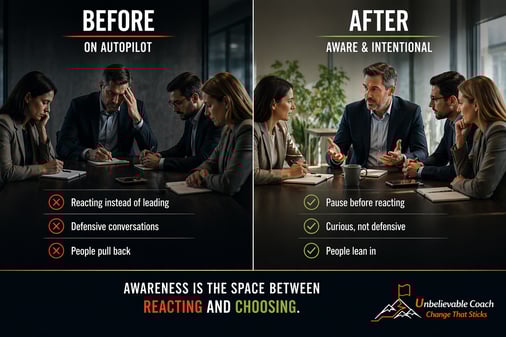
If awareness is low across a team:
- Reactivity spreads
- Pressure escalates
- Thinking narrows
If awareness increases:
- Space opens
- Conversations improve
- Better decisions follow
So the real question isn’t:
“Do people know what to do?”
It’s: “Can they see what they’re doing—while they’re doing it?”
 Because that determines whether anything actually changes.
Growth Demands Strategic Discipline
 In Beyond Belief, Nir Eyal argues that belief alone doesn’t create results—and he’s right.
But his critique reflects a simplified version of Dr. Joe Dispenza’s work—not how real change actually happens.
In the next blog, we’ll break down the difference between passive positive thinking and active mental and emotional conditioning—including why rehearsal, elevated emotion, and disciplined action are essential to creating results.
Because when done correctly…
It’s not about wishing for a future.
It’s about training yourself—and your team—to think, act, and perform differently under pressure.
.png.jpg?width=481&height=514&name=Its%20not%20a%20Capability%20Problem%20(Tight).png.jpg)
Most people don’t struggle because of capability —they struggle because their thoughts, emotions, and behaviors are neurologically conditioned to repeat the same results.
If you want to change results, awareness has to come before change.
You start by increasing awareness…
interrupting automatic patterns…
and helping both leaders and teams recognize what’s happening in real time.
Because until people can see what they’re doing…
They’ll keep doing what they did yesterday.
That’s how organizations move from reactive productivity
to intentional performance.
Through Change Your Mind. Create New Results training: I help leaders interrupt stress-driven conditioning, regulate under pressure, and build cultures driven by intention rather than reaction.
If you're ready to move from reactive productivity to intentional performance, let’s talk!
Doug Wick
Unbelievable Coach
Change That Sticks
Schedule a Strategic Conversation
Change the Pattern. Change the Result.
NEXT BLOG - Beyond Belief: Why Positive Thinking Isn’t the Problem—What Critics Miss About Real Change



.jpeg?width=150&height=135&name=Hand%20with%20marker%20writing%20the%20question%20Whats%20Next_%20(1).jpeg "Schedule a meeting")