
In my last blog, I shared a truth I could not see while I was living it: I had become successful at functioning under stress.
I was exercising. I was working. I was serving clients, solving problems, traveling, answering calls, and carrying significant responsibility. On the surface, I appeared capable and productive.
I did not think I was stressed. I thought I was doing what success required.
 Looking back, I can see something I could not recognize then: stress had become so familiar it no longer felt unusual.
It felt like me.
That is one of the dangers of prolonged stress. You do not have to feel overwhelmed by stress for it to shape how you think, feel, and behave. When pressure is repeated often enough, the body becomes accustomed to operating in a heightened state of readiness.
Eventually, survival feels normal.
When the Emergency Never Quite Ends
The stress response (survival) is not the enemy. In the short term, it helps us respond to a challenge. The brain and body mobilize energy, sharpen attention, and prepare us to act. That response is valuable when a deadline is real, a decision is urgent, or danger is present.
The problem begins when the response designed for short-term demands is activated repeatedly without sufficient recovery.
 The body does not respond only to what is happening around us. It can also respond to what we anticipate, remember, or continually rehearse in our minds.
- The difficult conversation that has not happened.
- The financial problem that may occur.
- The employee who might disappoint us again.
- The outcome we fear we will be unable to control.
Each time we mentally return to the problem, we recreate elements of the same internal state. Over time, tension, urgency, impatience, and vigilance become familiar—not because we consciously choose them, but because we have practiced them.
When Calm Feels Uncomfortable
This helps explain a strange experience many high-performing people have: when there is no immediate problem to solve, they feel uncomfortable.
%208-31-26.png?width=296&height=296&name=When%20Calm%20Feels%20Uncomfortable%20(anticipation)%208-31-26.png) You sit down to rest and reach for your phone. A quiet weekend feels unproductive. An open space on the calendar creates uneasiness. If work is going well, the mind searches for what might go wrong. If no crisis exists, you focus on a small issue until it becomes one.
You sit down to rest and reach for your phone. A quiet weekend feels unproductive. An open space on the calendar creates uneasiness. If work is going well, the mind searches for what might go wrong. If no crisis exists, you focus on a small issue until it becomes one.
It is not because you enjoy stress. Your system is simply more familiar with urgency than ease.
I recognize this pattern in my own life. I was so accustomed to motion and responsibility that stopping did not feel natural. There was always another client need, another trip, another meeting, or another problem demanding my attention. Exercise was valuable, but it did not automatically undo the internal state I repeatedly returned to throughout the day.
My body looked active and healthy. My behavior was being driven by pressure.
Stress Does Not Always Look Like Struggle
Sometimes stress looks like achievement.
It can look like the leader who responds to every message immediately, cannot delegate without checking the work, becomes impatient when others move more slowly, or believes the organization will fall behind if they stop pushing.
Because that leader is still producing results, neither the leader nor the people around them may recognize the cost. But the pattern often reveals itself in smaller moments:
%208-31-26.png?width=270&height=270&name=Stress%20Does%20Not%20Always%20Look%20Like%20Struggle%20(On%20to%20the%20next)%208-31-26.png) You have difficulty being present when nothing urgent is happening.
You have difficulty being present when nothing urgent is happening.- Rest creates guilt rather than restoration.
- Your mind continually rehearses problems that have not occurred.
- Minor delays or mistakes produce a disproportionate reaction.
- You feel responsible for controlling outcomes—and perhaps other people.
- You move quickly from one accomplishment to the next without experiencing satisfaction.
- The people closest to you experience your impatience, even when colleagues see only your performance.
- You call it drive, discipline, or high standards, but underneath it is a persistent sense that something may go wrong.
None of these observations prove someone is living in chronic stress. But they are invitations you should become curious.
Awareness Comes Before Change
The first step - don’t judge yourself or immediately try to eliminate every source of pressure.
The first step is to notice the pattern.
Observe rather than analyze.
Ask yourself:
 What happens inside me when there is nothing to fix?
Can I be still without searching for stimulation, urgency, or a problem?
How does my body feel during an ordinary workday—tight, rushed, guarded, or at ease?
Do I respond to what is happening, or to what I fear might happen?
What do the people closest to me experience when I am under pressure?
Awareness creates a small but powerful separation between who you are and the state you have repeatedly practiced.
You are not your impatience.
You are not your urgency.
You are not the tension your body has learned to carry.
These may be conditioned patterns—and a pattern that can be observed can begin to be changed.
I could not change my relationship with stress while I believed it was simply my personality or the price of achievement. I first had to recognize what felt normal was not necessarily healthy, effective, or inevitable.
That same awareness is available to every leader.
The question is not only, “Am I getting results?”
It is also, “Who am I repeatedly becoming while I produce them?”
Change the Pattern. Change the Result.
NEXT BLOG - Are YOU Addicted to Stress?
 You say you want greater peace, balance, and control. Yet when life becomes quiet, some of us feel restless—so we create another deadline, search for another problem, or become drawn into urgency, conflict, drama, and overwork.
Have our minds and bodies become so accustomed to the chemicals of stress that pressure feels more familiar than peace?
In the next blog, we’ll explore why we may unconsciously recreate the stress we say we want to escape—and how awareness can help us interrupt the pattern.
Ready to Create Change That Sticks?
If you or your leadership team are ready to stop repeating old patterns and begin installing new ones, let's have a conversation.
Through Change Your Mind. Create New Results.™, I'll show you how to use neuroscience to intentionally rewire the thinking, emotions, and behaviors that drive performance, leadership, and culture.
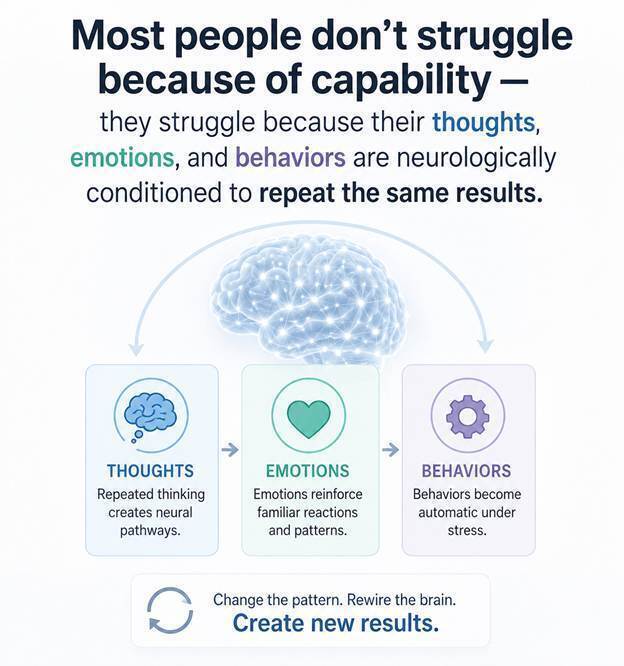
Most people don't struggle because of capability—they struggle because their thoughts, emotions, and behaviors are neurologically conditioned to repeat the same results.
Through Change Your Mind. Create New Results.™, I help leaders interrupt stress-driven conditioning, regulate themselves under pressure, and create cultures driven by intention instead of survival.

Change the Pattern. Change the Result.
Unbelievable Coach — Change That Sticks.
Ready to Create Different Results?
If you're exhausted by pressure, stress, emotional reactivity, or repeating the same leadership patterns, maybe it's time to stop managing symptoms and start changing the conditioning that drives them.
Real change begins when leaders learn how to regulate themselves under pressure—because regulated leaders create healthier cultures, clearer communication, and stronger performance.
If you want to create a different future for yourself and your organization, let's start the conversation.
Schedule your complimentary 30-minute Leadership Conversation today:
https://unbelievablecoach.com/contact/
Because lasting transformation doesn't happen by accident.
It happens one repeated choice at a time.
Schedule a Strategic Conversation
https://meetme.so/DouglasAWick
Visit: Unbelievable Coach
NEXT BLOG - Are YOU Addicted to Stress?



.jpeg?width=150&height=135&name=Hand%20with%20marker%20writing%20the%20question%20Whats%20Next_%20(1).jpeg "Schedule a meeting")