
Most leaders don’t repeat problems because they lack intelligence, strategy, or experience.
They repeat them because of memory.
Not conscious memory.
Emotional memory.
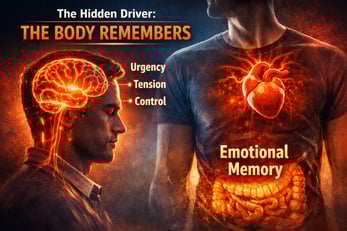
The Hidden Driver: The Body Remembers
 In leadership, we tend to believe:
“I’ll just think differently next time.”
But under pressure, that rarely happens.
Why?
Because the body has already memorized the past.
When a stressful situation occurs—a missed deadline, a difficult employee, a customer issue—the brain doesn’t pause to create a new response.
It searches for what’s familiar.
And what’s familiar isn’t always what’s effective.
It’s what’s been repeated.
How the Memory Trap Works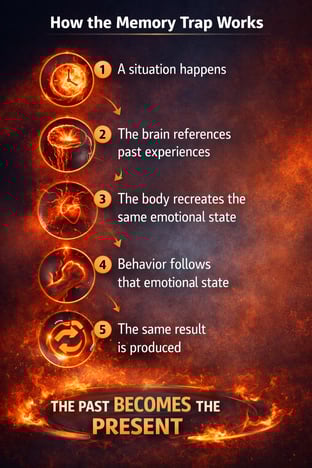
Here’s the pattern most leaders never see:
- A situation happens
- The brain references past experiences
- The body recreates the same emotional state
- Behavior follows that emotional state
- The same result is produced
Not because the leader chose it.
Because the leader felt it first.
And the moment the body takes over, the past becomes the present.
Why Smart Leaders Get Stuck Here
This is where it gets uncomfortable—but important.
Even high-performing leaders fall into this trap because:
- The brain is wired for efficiency, not innovation
- Familiar emotions feel “true,” even when they’re outdated
- Under pressure, the nervous system defaults to survival mode
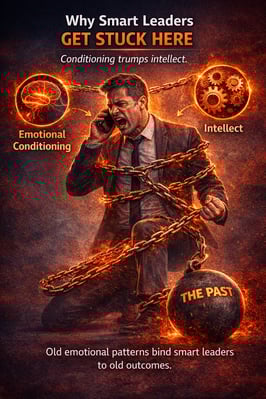 So instead of responding with clarity…
Leaders react with:
- urgency
- control
- frustration
- defensiveness
Not intentionally.
Conditionally.
The Cost to Culture
This isn’t just personal—it’s organizational.
Because teams don’t respond to strategy.
They respond to state.
When a leader operates from:
- tension → the team tightens
- urgency → the team rushes
- frustration → the team withdraws
Over time, the organization begins to mirror the leader’s emotional patterns.
And what started as a moment…
Becomes a culture.
Breaking the Memory Trap
You don’t break this pattern by trying harder.
You break it by becoming aware of it—before it runs.
That’s the shift.
Not from:
reaction → better reaction
But from:
reaction → awareness → intentional response
Here’s a simple way to begin:
 1. Recognize the familiar feeling
When pressure hits, ask: “Have I felt this before?”
If the answer is yes—you’re in the past.
2. Interrupt the emotional pattern
Pause. Breathe. Slow it down.
This isn’t soft—it’s neurological.
You’re disrupting a conditioned response.
3. Choose the state you want to lead from
Instead of asking: “What should I do?”
Ask:
“Who do I want to be in this moment?”
Clarity doesn’t come from thinking harder.
It comes from changing your state first.
A Different Kind of Leadership
 The leaders who create the strongest cultures aren’t the ones with the best strategies.
They’re the ones who:
- recognize their patterns
- regulate their emotional state
- lead from intention instead of memory
Because when you change the state…
You change the behavior.
And when you change the behavior…
You change the result.
Closing Thought
If you keep seeing the same problems in your business…
It may not be the system.
It may not be the people.
It may be the emotional memory driving your leadership.
And the moment you become aware of it—
You gain the ability to change it.
Growth demands Strategic Discipline.
 Most leaders don’t struggle to start change—they struggle to sustain it.
They gain insight, feel momentum, and then—under pressure—old patterns return. Not because the strategy failed, but because something deeper never changed.
In the next article, The Identity Gap – Why Leaders Struggle to Sustain Change, we’ll explore why change doesn’t stick—and how aligning identity with intention is what finally makes it last.
Most people don’t struggle because of capability — they struggle because their thoughts, emotions, and behaviors are neurologically conditioned to repeat the same results.
.png.jpg?width=481&height=514&name=Its%20not%20a%20Capability%20Problem%20(Tight).png.jpg) Capability isn’t the problem.
Capability isn’t the problem.
Conditioning is.
When stress becomes the default state, even smart leaders repeat predictable outcomes. Change the pattern — change the result.
Through Change Your Mind. Create New Results training, I help leaders interrupt stress-driven conditioning, regulate under pressure, and build cultures driven by intention instead of reaction.
If you're ready to move from reactive productivity to intentional performance, let’s talk.
Doug Wick. Unbelievable Coach
Schedule a Strategic Conversation
Change the Pattern. Create New Results.
 NEXT BLOG – The Memory Trap - Why Leaders Keep Recreating the Same Problems



.jpeg?width=150&height=135&name=Hand%20with%20marker%20writing%20the%20question%20Whats%20Next_%20(1).jpeg "Schedule a meeting")