
Most leaders believe culture is shaped by strategy, policies, or incentives.
But neuroscience suggests something different.
Culture is often the collective result of repeated leadership patterns.
In other words, how leaders think under pressure becomes how organizations behave.
This is what I call The Leadership Pattern Loop.
And once you see it, you begin to understand why even smart, capable leaders can unintentionally create cultures of stress, hesitation, or reactive decision-making.
The Leadership Pattern Loop
Every leader operates within a neurological loop:
Thought → Emotion → Behavior → Culture
It starts with a thought.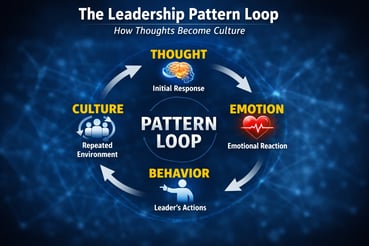
A leader interprets a situation — a missed shipment, a frustrated customer, an unexpected cost increase.
That thought generates an emotional reaction — frustration, urgency, pressure.
That emotional state drives behavior — tone of voice, communication style, decision speed, level of control.
And those behaviors repeat.
Team members experience them repeatedly, and over time, they begin to anticipate them.
Eventually, the behavior becomes normalized.
This is where individual patterns become organizational culture.
Not because leaders intend it.
But because the brain is designed to repeat what is familiar.
Why Smart Leaders Still Create Reactive Cultures
Many executives assume culture problems come from the team.
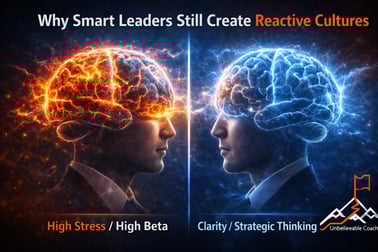 But often the pattern begins at the top.
When leaders operate primarily in high-stress brainwave states — what neuroscience calls high-beta — the brain becomes focused on survival:
urgent problems, immediate threats, short-term reactions.
In this state, the brain prioritizes speed and defense, not creativity or strategic thinking.
The result?
Leaders may unintentionally create environments where:
• Employees wait for instructions instead of thinking independently
• Decisions become reactive instead of strategic
• Communication becomes tense or cautious
• Innovation slows because people focus on avoiding mistakes
None of this happens because people lack capability.
It happens because the emotional tone of leadership shapes the neurological environment of the organization.
Teams adapt to the state leaders operate in most often.
Over time, that state becomes culture.
Culture Is a Repeated Emotional Environment
Think about the best organizations you’ve worked in.
What made them effective?
 It usually wasn’t the org chart.
It was the emotional environment.
People felt clear.
Focused.
Able to think.
Now think about organizations that struggled.
Often, the environment felt different:
Unpredictable.
Reactive.
Tense.
The difference between those environments often begins with leadership regulation under pressure.
When leaders consistently respond from clarity rather than reaction, something powerful happens:
The organization begins to stabilize.
People think more clearly.
Communication becomes more direct.
Decision-making improves.
Innovation increases because people are no longer operating from stress.
Breaking the Leadership Pattern Loop
The key insight from neuroscience is simple:
You cannot change culture until you change the patterns that create it.
In the Change Your Mind. Create New Results training, we help leaders recognize the internal loop driving their leadership behavior.
Once leaders become aware of the thought–emotion–behavior cycle, they can begin interrupting automatic reactions.
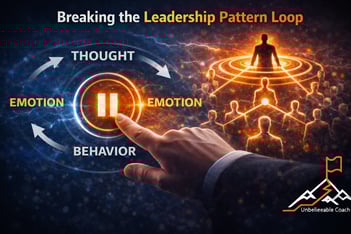 Instead of reacting to pressure, they learn to pause.
Instead of reinforcing familiar patterns, they create new ones.
This is not about positive thinking.
It is about neurological regulation.
When leaders intentionally shift their internal state — from stress to clarity — they begin operating from different brainwave patterns associated with creativity, insight, and strategic thinking.
Those shifts ripple outward.
Over time, the leadership pattern loop begins producing something very different:
A culture built on clarity instead of urgency
Intention instead of reaction
strategic thinking instead of constant problem solving
Culture Always Reflects Leadership Patterns
Every organization has patterns.
The question is whether those patterns were created intentionally or unintentionally.
Because once a pattern is repeated long enough, it becomes the invisible operating system of the company.
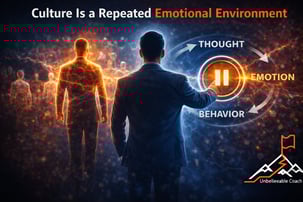 Leaders who understand this have a tremendous advantage.
They stop trying to fix culture directly.
Instead, they focus on something more powerful:
the neurological patterns driving their leadership behavior.
Change the pattern.
Change the result.
And over time… Change the culture.
Growth demands Strategic Discipline.
But this raises an important question.
I f leadership patterns shape culture, what determines the patterns leaders repeat?
The answer lies deeper in how the brain stores experience, memory, and emotional conditioning.
In the next blog, we explore: “The Memory Trap: Why Leaders Keep Recreating the Same Problems.”
Most people don’t struggle because of capability — they struggle because their thoughts, emotions, and behaviors are neurologically conditioned to repeat the same results.
Capability isn’t the problem.
Conditioning is.
When stress becomes the default state, even smart leaders repeat predictable outcomes. Change the pattern — change the result.
.png.jpg?width=481&height=514&name=Its%20not%20a%20Capability%20Problem%20(Tight).png.jpg)
Through Change Your Mind. Create New Results training, I help leaders interrupt stress-driven conditioning, regulate under pressure, and build cultures driven by intention instead of reaction.
If you're ready to move from reactive productivity to intentional performance, let’s talk.
Doug Wick
Unbelievable Coach
Schedule a Strategic Conversation
Change the Pattern. Create New Results.
NEXT BLOG – The Memory Trap: Why Leaders Keep Recreating the Same Problems



.jpeg?width=150&height=135&name=Hand%20with%20marker%20writing%20the%20question%20Whats%20Next_%20(1).jpeg "Schedule a meeting")