
Most leaders don’t struggle to change.
They struggle to stay changed.
They read the book.
Attend the workshop.
Have the insight.
And for a short time…
 They think differently.
Act differently.
Show up differently.
Slowly—almost predictably—
They return to old patterns.
Not because the strategy didn’t work.
Because their identity didn’t change.
The Real Problem Isn’t Behavior
Most leadership development focuses on:
- new strategies
- new behaviors
- new habits
But behavior doesn’t operate independently.
It’s driven by identity.
.png?width=286&height=229&name=The%20Real%20Problem%20Isnt%20Behavior%20Unbelievable%20Coach%20(under).png) If a leader still sees themselves as:
If a leader still sees themselves as:
- the one who must control outcomes
- the one who must respond immediately
- the one responsible for everything
Then even if they try to change…
They will eventually return to what feels like themselves.
Because at some level:
We don’t act in alignment with our goals.
We act in alignment with who we believe we are.
Why Change Doesn’t Stick
This is where most leaders get frustrated.
They say:
“I know what to do… I’m just not doing it consistently.”
That’s not a discipline problem.
It’s an identity conflict.
Here’s what’s happening beneath the surface:
- The leader adopts a new idea
- They attempt new behaviors
- The old identity feels uncomfortable or threatened
- The body pulls them back to familiar patterns
- The old results return
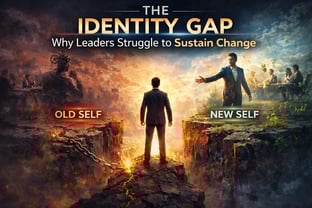
%203-30-26.png?width=324&height=216&name=Closing%20the%20Identity%20Gap%20(logo)%203-30-26.png) This is the Identity Gap.
This is the Identity Gap.
The space between:
- what you know
- and who you are being
The Role of Emotional Conditioning
This connects directly to what we’ve already discussed.
The Memory Trap keeps emotional patterns alive.
The Refractory Period keeps those emotions active longer than they should be.
And identity?
Identity is built on those repeated emotional states.
If a leader is repeatedly feeling:
- urgency
- pressure
- responsibility
- control
Then over time, they don’t just experience those states—
They become them.
So when they try to change…
It doesn’t feel natural.
It feels like they’re being someone else.
Why This Matters for Culture
This isn’t just personal development.
It’s organizational impact.
Because leaders don’t just model behavior.
They model identity.
If a leader identifies as:
- reactive → the culture becomes reactive
- controlling → the culture becomes dependent
- pressured → the culture becomes tense
But when a leader begins to shift identity toward:
- calm
- intentional
- clear
The culture follows.
Not because of policy.
Because of the consistency of state.
%203-30-26.png?width=366&height=244&name=Why%20This%20Matters%20to%20Culture%20(Logo)%203-30-26.png) Closing the Identity Gap
Closing the Identity Gap
You don’t close the gap by trying harder.
You close it by becoming aware of who you are being—moment to moment.
Here’s a simple starting point:
1. Notice the identity behind the reaction
When you feel triggered, ask:
“Who am I being right now?”
Not, what am I doing?
Who am I being?
2. Define the identity you want to lead from
- Clear.
- Calm.
- Decisive.
- Intentional.
Pick it.
3. Practice that identity before the pressure hits
Because under pressure…
You don’t rise to your goals.
You fall back to your conditioning or habits.
A Different Standard of Leadership
The leaders who sustain change aren’t the most disciplined.
They’re the most aligned.
Their thoughts, emotions, and behaviors are consistent with who they’ve decided to be.
%203-30-26.png?width=1536&height=1024&name=A%20Different%20Standard%20of%20Leadership%20(logo)%203-30-26.png) Because once identity shifts…
Because once identity shifts…
Behavior follows naturally.
And results become predictable.
Closing Thought
If you keep trying to change your behavior…
But your results keep drifting back…
You may not have a strategy problem.
You may have an identity gap.
And the moment you begin to change who you are being—
Everything else begins to follow.
Growth demands Strategic Discipline.
 Even when leaders close the identity gap, something else can quietly pull them backward—the environment around them.
Culture isn’t neutral. It reinforces what’s familiar, not what’s new.
In the next article, The Environment Effect: Why Your Culture Pulls You Back, we’ll explore why change often fades inside existing environments—and how leaders can reshape culture so new patterns stick.
Most people don’t struggle because of capability — they struggle because their thoughts, emotions, and behaviors are neurologically conditioned to repeat the same results.
Capability isn’t the problem.
Conditioning is.
.png.jpg?width=509&height=544&name=Its%20not%20a%20Capability%20Problem%20(Tight).png.jpg) When stress becomes the default state, even smart leaders end up repeating predictable outcomes. Change the pattern — change the result.
When stress becomes the default state, even smart leaders end up repeating predictable outcomes. Change the pattern — change the result.
Through Change Your Mind. Create New Results training: I help leaders interrupt stress-driven conditioning, regulate under pressure, and build cultures driven by intention rather than reaction.
If you're ready to move from reactive productivity to intentional performance, let’s talk.
Doug Wick, Unbelievable Coach
Change That Sticks
Schedule a Strategic Conversation
Change the Pattern. Create New Results.
NEXT BLOG – “The Environment Effect: Why Your Culture Pulls You Back”



.jpeg?width=150&height=135&name=Hand%20with%20marker%20writing%20the%20question%20Whats%20Next_%20(1).jpeg "Schedule a meeting")