
In Beyond Belief, Nir Eyal makes a critical point: belief alone doesn’t create results.
On that, there’s no disagreement.
In fact, one of the most important risks in personal and professional development is exactly what he describes—confusing intention with execution.
Thinking about change isn’t the same as creating it.
And belief without action can become a trap.
Where the Critique Lands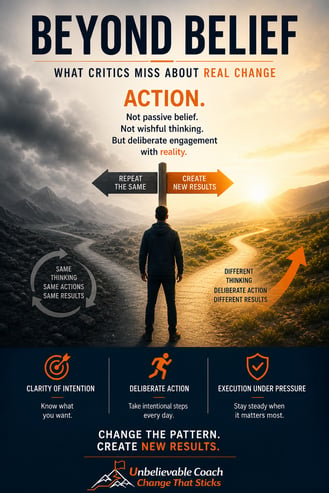
Eyal challenges what he frames as “magical thinking”—the idea that visualizing a future or aligning your thoughts is enough to make outcomes appear.
He contrasts this with research like Gabriele Oettingen’s mental contrasting, where individuals not only define a goal, but actively identify obstacles and prepare responses.
That work matters.
Because it introduces something essential:
Action.
Not passive belief.
Not wishful thinking.
But deliberate engagement with reality.
Where the Conversation Becomes Incomplete
Where this critique falls short is in how it represents the work of Joe Dispenza.
 Because Dr. Joe’s work does not stop at belief.
It requires action—repeated, structured, intentional action.
- Regulating your physiology through breathwork
- Practicing mental rehearsal to condition new responses
- Writing and reflecting to increase awareness
- And most importantly, acting differently in your day when it matters
This is not passive.
It’s disciplined.
And it aligns more closely with action-based models than critics often acknowledge.
The Real Issue: Not All Action Is Equal
Here’s the part most people miss—on both sides.
Taking action is necessary.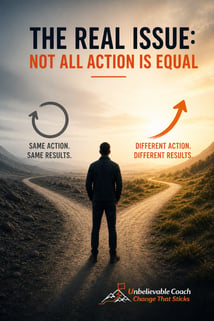 But taking the same action from the same state produces the same result.
This is where many leaders get stuck.
They take action.
They try harder.
They push more.
They engage problems directly.
But under pressure, they default to the same thinking, the same emotional reactions, and the same behaviors.
So the “action” changes nothing.
Because the pattern hasn’t changed.
What Actually Creates Change
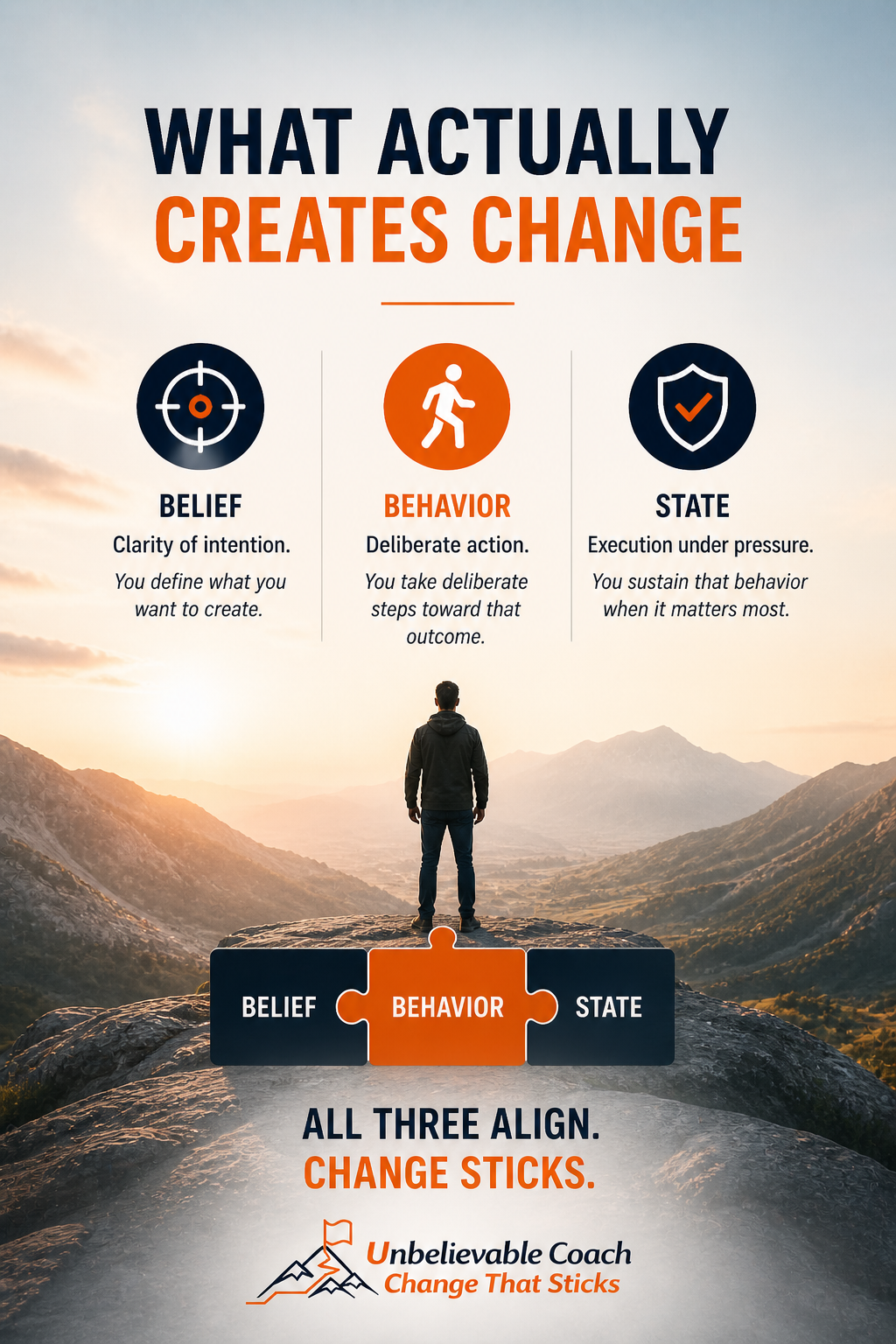 Real change happens when three things align:
1. Belief (Clarity of intention)
You define what you want to create.
2. Behavior (Action)
You take deliberate steps toward that outcome.
3. State (Execution under pressure)
You can sustain that behavior when it matters most.
Miss any one of these—and change doesn’t stick.
- Belief without action → no movement
- Action without state change → repeated outcomes
- State without direction → no meaningful progress
This is why both sides of the conversation are partially right.
And partially incomplete.
Why Action Fails Without Preparation
This is where Dr. Joe’s work—and your Change Your Mind. Create New Results training—adds something critical.
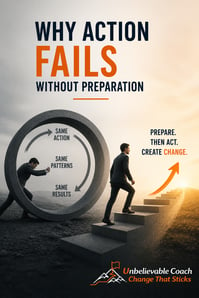 It prepares people to take different actions under pressure.
Because if the nervous system is still conditioned to react:
- The same meeting triggers the same response
- The same person creates the same reaction
- The same pressure produces the same behavior
And action becomes repetition.
Not transformation.
A Real-World Proof Point
This isn’t theoretical for me.
In 2012, I was diagnosed with acute myeloid leukemia with less than a 3% chance of survival.
 Belief mattered—but it wasn’t enough.
What made the difference was combining belief with action and consistency under pressure.
I created a daily dashboard.
I exercised when I could.
I maintained a work schedule at the hospital.
Not perfectly. But intentionally.
That experience reinforced something I now see in leaders every day:
Change doesn’t happen because you believe.
It happens because you act—and keep acting—aligned with that belief, even when it’s hard.
Leadership Reality
This shows up every day in business.
A leader faces a challenge:
- A missed number
- A client issue
- A breakdown in execution
 They take action.
But their tone tightens.
Their thinking narrows.
Their communication changes.
The team feels it—and adapts.
Now the culture reflects the reaction.
Not the strategy.
This is why action alone doesn’t fix the problem.
And belief alone doesn’t either.
The Real Integration
The most effective leaders don’t choose between belief and action.
They integrate both—and add something else:
They hone their ability to execute under pressure.
 They prepare for the moment when it’s hardest to follow through.
They don’t just define the future.
They become capable of delivering it.
The Bottom Line
Nir Eyal is right:
Belief alone doesn’t create results.
But the more complete truth is this:
Action creates results.
Only when the person taking action changes the pattern driving it.
That’s where real change happens.
Growth Demands Strategic Discipline
You can know exactly what to do—and still react the same way under pressure.
That’s not a belief problem.
It’s a pattern.
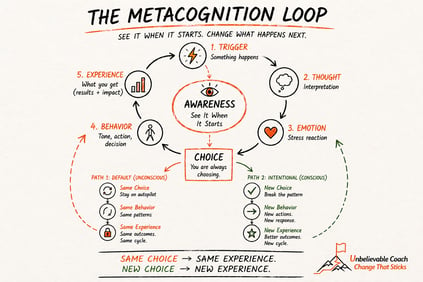 Next week, I’ll break down the exact moment where those patterns can be interrupted—and how leaders start creating different results in real time.
Same choice → same experience.
New choice → new experience.
NEXT BLOG – “The Metacognition Loop: Why Leaders Repeat Patterns—and How to Break Them in Real Time.”
.png.jpg?width=481&height=514&name=Its%20not%20a%20Capability%20Problem%20(Tight).png.jpg) Most people don’t struggle because of capability — they struggle because their thoughts, emotions, and behaviors are neurologically conditioned to repeat the same results.
Most people don’t struggle because of capability — they struggle because their thoughts, emotions, and behaviors are neurologically conditioned to repeat the same results.
When leaders learn to interrupt stress-driven patterns, regulate their state, and operate with intention under pressure, everything changes—decision-making, communication, and culture.
That’s how organizations move from reactive productivity to intentional performance.
Through Change Your Mind. Create New Results training: I help leaders interrupt stress-driven conditioning, regulate under pressure, and build cultures driven by intention rather than reaction.
If you're ready to move from reactive productivity to intentional performance, let’s talk!

Doug Wick
Unbelievable Coach
Change That Sticks
Schedule a Strategic Conversation
Change the Pattern. Change the Result.
NEXT BLOG – “The Metacognition Loop: Why Leaders Repeat Patterns—and How to Break Them in Real Time.”



.jpeg?width=150&height=135&name=Hand%20with%20marker%20writing%20the%20question%20Whats%20Next_%20(1).jpeg "Schedule a meeting")