
Most leaders believe pressure reveals who they are.
In reality, pressure reveals what they’ve practiced.
When stress rises, most people don’t suddenly become intentional, emotionally intelligent, or strategic. They default to conditioned emotional patterns and automatic reactions.
That’s why a calm leader in a pressure moment stands out so dramatically.
Not because they feel no stress.
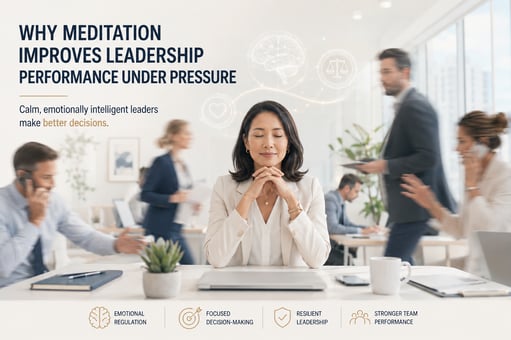 Because they’ve trained themselves not to become stressed.
And this is where meditation becomes one of the most misunderstood leadership tools in business.
Not a wellness exercise.
Not an escape.
Not “self-care.”
Meditation is nervous system training for leadership performance under pressure.
Most Organizations Operate in High Beta
Under pressure, the brain shifts into survival mode.
Deadlines.
Conflict.
Urgent emails.
Financial pressure.
Customer issues.
Team dysfunction.
Constant notifications.
 The nervous system begins operating in heightened stress chemistry.
In neuroscience terms, many leaders spend much of their day in high beta brainwave states — elevated stress frequencies associated with reactivity, over-analysis, emotional volatility, and narrowed thinking.
When this happens:
- patience decreases
- emotional reactions increase
- listening declines
- creativity narrows
- decision-making becomes reactive
- communication loses clarity
The problem is not capability.
Most leaders already know what they should do.
The problem is that under pressure, the body overrides intention.
The conditioned emotional state becomes the leader.
Why Meditation Improves Leadership Performance
Meditation trains leaders to observe themselves before reacting automatically.
That sounds simple.
 But in practice, it changes everything.
Because the moment a leader becomes aware of their internal state in real time, they create space between stimulus and reaction.
That space is leadership.
Without awareness:
pressure → emotion → reaction
With awareness:
pressure → observation → intentional response
Meditation strengthens the ability to:
- regulate emotional reactions
- interrupt stress chemistry
- recover faster after difficult interactions
- stay present in conflict
- think clearly under pressure
- lead conversations instead of emotionally joining them
This is emotional intelligence at the nervous system level.
Not personality.
Not motivation.
Not theory.
Training.
Calm Leaders Make Better Decisions
.png?width=386&height=257&name=Calm%20Leaders%20Make%20Better%20Decisions%206-01-29%20(too%20similar).png) Think about the leaders people trust most during uncertainty.
Think about the leaders people trust most during uncertainty.
They are rarely the loudest person in the room.
They are the most regulated.
The leader who remains clear while everyone else escalates creates stability for the entire organization.
Because emotional states spread.
A reactive leader creates reactive teams.
A regulated leader creates psychological safety, clearer thinking, and better execution.
Teams don’t just respond to strategy.
They respond to the nervous system of leadership.
That’s why one emotionally reactive conversation can affect an entire culture.
And why one calm, intentional response can completely change the direction of a meeting, relationship, or decision.
Meditation Is Mental Rehearsal for Pressure Moments
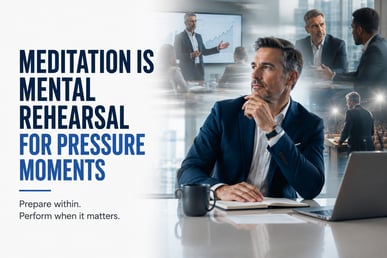 Most people think meditation is about relaxing.
But effective meditation is really rehearsal.
A leader mentally rehearses becoming the person they want to be before the pressure arrives.
More patient.
More focused.
More intentional.
More emotionally intelligent.
More resilient.
Over time, the brain and body begin recognizing that state as familiar.
This matters because in difficult moments, people don’t rise to their intentions.
They fall to their conditioning.
Meditation helps leaders condition a different internal response.
One that supports clarity instead of survival.
Why This Matters More Than Ever
 Today’s business environment rewards speed, urgency, and constant stimulation.
But leadership performance doesn’t improve through chronic stress.
In fact, chronic stress often reduces the exact qualities organizations need most:
- creativity
- collaboration
- communication
- innovation
- strategic thinking
- emotional regulation
Many leaders are trying to solve organizational problems while operating from dysregulated nervous systems.
That creates cultures where people react more than they think.
Meditation helps leaders interrupt that cycle.
Not by avoiding pressure —
but by becoming greater than it.
The Real Competitive Advantage
.png?width=396&height=264&name=The%20Real%20Competitive%20Advantage%20confident%206-01-26%20(best).png) The future belongs to leaders who can stay clear under pressure.
The future belongs to leaders who can stay clear under pressure.
Because clarity creates better decisions.
Better decisions create better cultures.
And culture ultimately determines results.
Meditation is not about becoming passive.
It’s about becoming conscious enough to lead intentionally when pressure would normally drive automatic behavior.
That’s the difference between reacting like the environment…
…and leading beyond it.
Next Blog:
.png?width=375&height=250&name=Self-actualization%20-%20Are%20You%20Where%20You%20Want%20to%20Be%20(Intro%20for%206-8-26%20blog).png) If nothing changed in your thinking, emotional reactions, habits, and behaviors over the next three years, where would your current patterns take you?
If nothing changed in your thinking, emotional reactions, habits, and behaviors over the next three years, where would your current patterns take you?
In our next blog, Self-Actualization: Are You Where You Want to Be?, we'll explore the gap between who you are today and who you're capable of becoming.
Most people don’t struggle because of capability — they struggle because their thoughts, emotions, and behaviors are neurologically conditioned to repeat the same results.
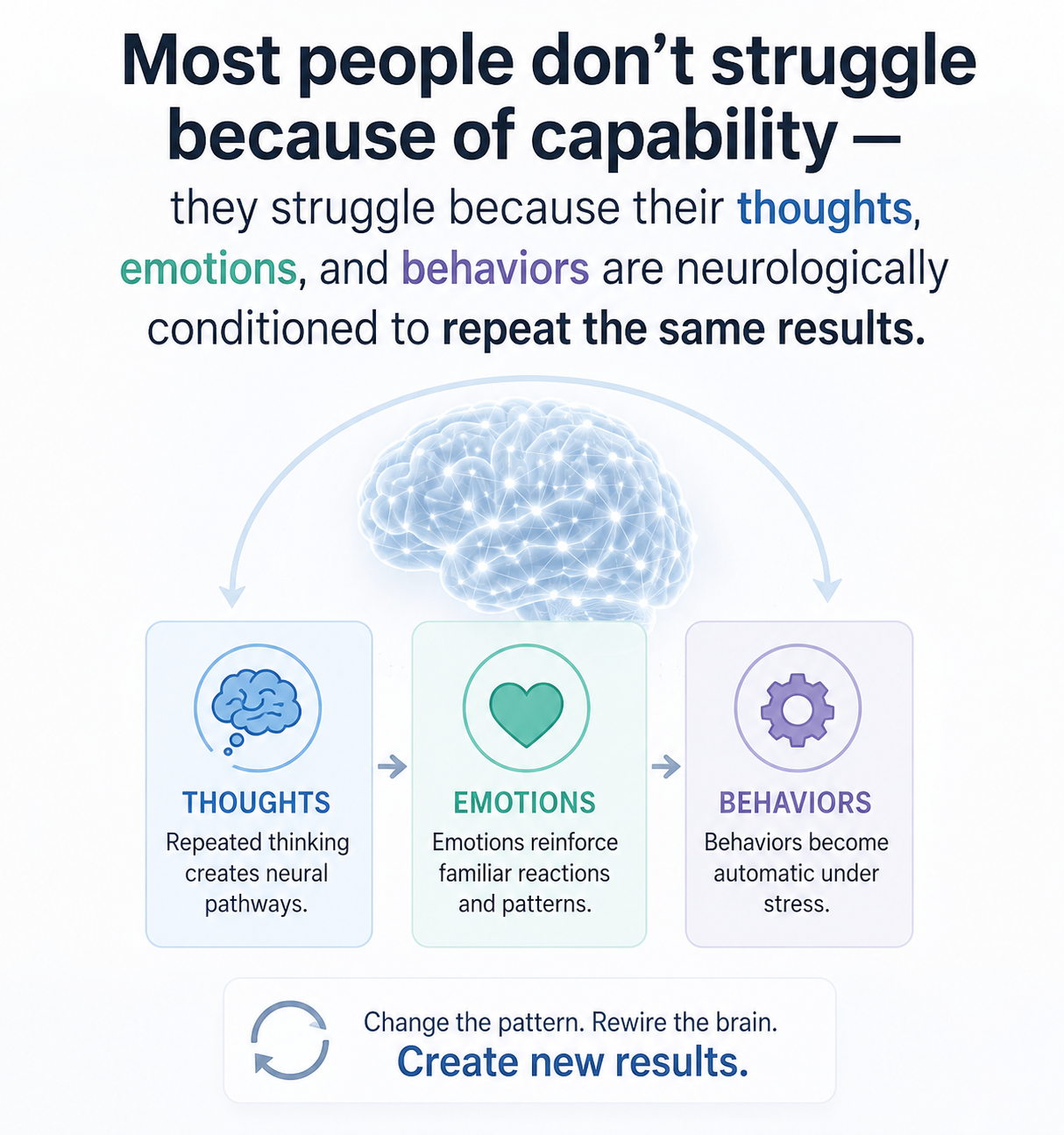
Through Change Your Mind. Create New Results, I help leaders interrupt stress-driven conditioning, regulate under pressure, and create cultures driven by intention instead of survival.
Change the Pattern. Change the Result.
Unbelievable Coach — Change That Sticks
Ready to Create Different Results?
If you’re exhausted from pressure, stress, emotional reactivity, or repeating the same leadership patterns, maybe it’s time to stop managing symptoms and start changing the conditioning driving them.
Real change begins when leaders learn how to regulate themselves under pressure — because regulated leaders create healthier cultures, clearer communication, and stronger performance.
If you want to create a different future for yourself and your organization, let’s start the conversation.
Visit: Unbelievable Coach
NEXT BLOG — Self-Actualization - Are You Where You Want to Be?.png?width=1536&height=1024&name=Self-actualization%20-%20Are%20You%20Where%20You%20Want%20to%20Be%20(Intro%20for%206-8-26%20blog).png)



.jpeg?width=150&height=135&name=Hand%20with%20marker%20writing%20the%20question%20Whats%20Next_%20(1).jpeg "Schedule a meeting")