
Real transformation doesn't become difficult because you're doing it wrong. It becomes difficult because you're leaving behind who you've been.
If you've ever tried to change a habit, become a calmer leader, communicate differently under pressure, or respond with greater intention, you've probably experienced something surprising.
Instead of feeling stronger...
you felt uncomfortable.%208-03-26.png?width=375&height=250&name=The%20River%20of%20Change%20%E2%80%94%20Why%20Most%20People%20Turn%20Back%20Too%20Soon%20(1)%208-03-26.png)
You questioned yourself.
You wondered if you were making a mistake.
For many leaders, that's the moment they stop.
They return to familiar habits—not because those habits produced the results they wanted, but because they felt predictable.
The irony is that this uncomfortable space isn't evidence you've failed.
It's evidence you've finally begun to change.
Why Change Feels Wrong
One of the greatest misconceptions about personal growth is believing that once we decide to change, the process should feel natural.
The opposite is usually true.
Our brains are designed to conserve energy by repeating familiar patterns. Over time, our thoughts, emotions, and behaviors become deeply practiced until they feel automatic.
Eventually, the body begins expecting those same emotional experiences.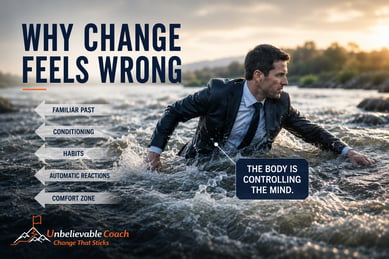
Stress feels familiar.
Frustration feels familiar.
Impatience feels familiar.
Even if we no longer want those patterns, they still feel like "us."
So the moment we choose to respond differently—to pause before reacting, to remain calm under pressure, or to lead with curiosity instead of certainty—we step outside what our brain and body recognize as familiar.
That's why change often feels uncomfortable before it feels empowering.
Not because something is wrong.
Because something is different.
The River of Change
Imagine standing on one side of a river.
Behind you is the person you've been.
The habits you've practiced.
The emotions you've repeated.
The reactions that have become automatic.
Across the river is the leader you're choosing to become.
Calmer.
More intentional.
More resilient.
Better able to think clearly under pressure.
Between those two identities is the River of Change.
Most people believe the river is the obstacle.
It isn't.
The river is the process.
The uncertainty you feel while crossing isn't punishment.
It's the space between an old identity that no longer serves you and a new identity that hasn't yet become familiar.
This is where many people turn back.
Not because they lack commitment.
Because they mistake discomfort for danger.
When the unfamiliar feels unsafe, the mind naturally wants to return to what it already knows—even if what it knows is exactly what created the results it's trying to change.
The greatest mistake people make is believing that discomfort means they're on the wrong path.
In reality, discomfort is often evidence they're finally leaving the familiar one.
Crossing the River Without Turning Back
Dr. Joe Dispenza often teaches that when you decide to become someone different, your body remembers the person you used to be.
Your body has been conditioned by thousands of repetitions.
When you choose differently, your body doesn't immediately celebrate.
It protests.
%20best%20-%208-03-26.png?width=378&height=252&name=Crossing%20the%20River%20Without%20Turning%20Back%20(1)%20best%20-%208-03-26.png) That protest can sound surprisingly convincing.
That protest can sound surprisingly convincing.
"This isn't working."
"You're pretending."
"Just go back to the way you've always handled this."
Those thoughts aren't proof you're failing.
They're simply familiar patterns trying to pull you back toward the known.
This is where leadership becomes less about willpower and more about awareness.
Instead of fighting the discomfort, recognize it.
Instead of interpreting it as failure, expect it.
Keep rehearsing the leader you're becoming.
Keep practicing the emotions you want to live from.
Keep making one intentional choice at a time.
Each repetition teaches your brain and body something new.
Eventually, what once felt unfamiliar begins to feel natural.
The river doesn't disappear.
You simply discover you've crossed it.
The Leader Who Emerges
Most people never fail because they're incapable of change.
They fail because they abandon the process during its most uncomfortable stage.
The leaders who create lasting transformation understand something different.
They don't expect the journey to feel easy.
They expect it to feel unfamiliar.
And they keep moving anyway.
Every intentional choice becomes another step across the river.
Eventually, one day, you realize you're responding differently without thinking about it.
Not because you're trying harder.
Because you've become someone different.
That's when the results begin showing up—not only inside you, but in your relationships, your leadership, your culture, and your organization.
The person who stepped into the river is no longer the person who stepped out.
Reflection%208-03-26.png?width=1536&height=1024&name=Reflection%20-%20Tempted%20to%20turn%20back%20to%20familiar!%20(Male)%208-03-26.png)
- Where in your leadership are you mistaking discomfort for danger?
- What familiar pattern keeps calling you back when you try to change?
- What would happen if you viewed discomfort as evidence that you're growing instead of proof that you're failing?
- What's one intentional response you can continue practicing this week, even if it still feels unfamiliar?
Next Blog - New Results — When Your Inner Change Begins Changing Your Outer World
 Real transformation begins internally, but eventually it becomes visible.
In the next article, we'll explore why the changes you've been practicing are finally beginning to appear in your leadership, your relationships, your decisions, and the results you create—and why those outer results are simply evidence of the inner person you've become.
Ready to Create Change That Sticks?
If you or your leadership team are ready to stop repeating old patterns and begin installing new ones, let's have a conversation.
Through Change Your Mind. Create New Results.™, I'll show you how to use neuroscience to intentionally rewire the thinking, emotions, and behaviors that drive performance, leadership, and culture.
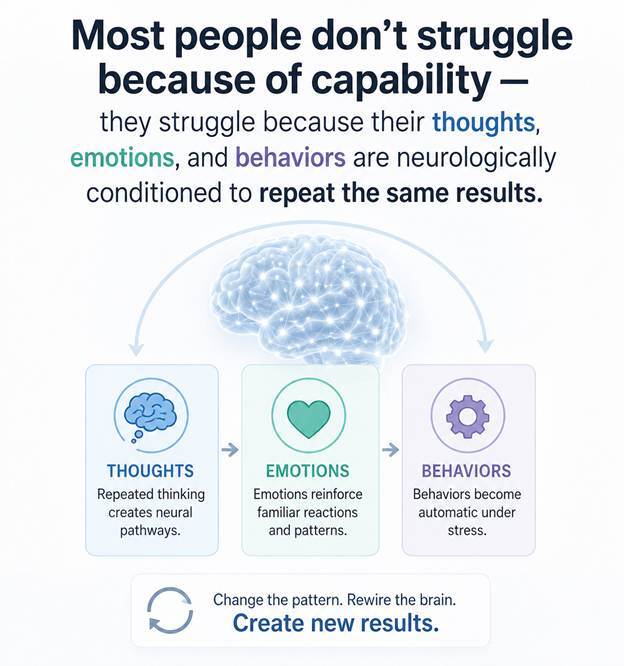
Most people don't struggle because of capability—they struggle because their thoughts, emotions, and behaviors are neurologically conditioned to repeat the same results.
Through Change Your Mind. Create New Results.™, I help leaders interrupt stress-driven conditioning, regulate themselves under pressure, and create cultures driven by intention instead of survival.

Change the Pattern. Change the Result.
Unbelievable Coach — Change That Sticks.
Ready to Create Different Results?
If you're exhausted by pressure, stress, emotional reactivity, or repeating the same leadership patterns, maybe it's time to stop managing symptoms and start changing the conditioning that drives them.
Real change begins when leaders learn how to regulate themselves under pressure—because regulated leaders create healthier cultures, clearer communication, and stronger performance.
If you want to create a different future for yourself and your organization, let's start the conversation.
Schedule your complimentary 30-minute Leadership Conversation today:
https://unbelievablecoach.com/contact/
Because lasting transformation doesn't happen by accident.
It happens one repeated choice at a time.
Schedule a Strategic Conversation
https://meetme.so/DouglasAWick
Visit: Unbelievable Coach
NEXT BLOG - New Results — When Your Inner Change Begins Changing Your Outer World



.jpeg?width=150&height=135&name=Hand%20with%20marker%20writing%20the%20question%20Whats%20Next_%20(1).jpeg "Schedule a meeting")