
Are You Addicted to Stress?
My first reaction to this question is:
“Of course not. Why would I be addicted to something I don't even like?”
That's why stress can be so difficult to recognize.
All of us may genuinely want fewer problems. Less conflict. Fewer interruptions. More cooperative employees. More time. More peace.
Yet something interesting can happen when life actually becomes quieter.
 We become restless.
- Check our email.
- Look for the next problem.
- Think about tomorrow.
- Replay yesterday's disagreement.
- Wonder what someone meant by that comment.
Here's the possibility most of us never consider:
You may not be addicted to the problems in your life.
What you may actually be addicted to is the rush those problems create.
It’s Not the Problem. It’s the Adrenaline Rush.
So what are we actually responding to?
 The adrenaline rush those problems help create.
Stress is a natural survival response. When we perceive a threat, our sympathetic nervous system prepares us to respond. Heart rate increases. Energy is mobilized. Blood flow shifts toward the muscles we may need for action. Our attention narrows. Pupils dilate, our mouth dries, and suddenly—we perk up!
That response is incredibly useful when we're facing an actual emergency.
But in today's work environment, our emergencies aren't the same as the threats our early ancestors faced:
- An angry customer.
- A missed forecast.
- A difficult employee.
- An overflowing inbox.
- A disagreement with a coworker.
- Uncertainty about what happens next.
Our body can react to these situations as though something dangerous is happening.
And the resulting stress hormones provide a powerful jolt of energy.
That rush is what we can become conditioned to.
Do that often enough and the body can become accustomed to the arousal.
The emergency begins to feel normal.
As Dr. Joe Dispenza notes in Evolve Your Brain, “We choose to remain in the same circumstances because we have become addicted to the emotional state they produce and the chemicals that arouse that state of being.”
When Urgency Becomes Familiar
This helps explain something I've seen repeatedly in business.
%209-07-26.png?width=339&height=226&name=When%20Urgency%20Becomes%20Familiar%20(Tense)%209-07-26.png) People sincerely say they want less stress while unconsciously participating in patterns that keep producing it.
People sincerely say they want less stress while unconsciously participating in patterns that keep producing it.
- Drama creates stimulation.
- Conflict creates stimulation.
- Deadlines create stimulation.
- Putting out fires creates stimulation.
- Even worrying about something that hasn't happened yet creates stimulation.
Eventually, a calm day can feel strangely uncomfortable.
We may interpret that discomfort as meaning we should be doing something.
So we find something.
- Another email.
- Another problem.
- Another person who needs correcting.
- Another reason to worry.
The circumstances may change, but the emotional state remains remarkably familiar.
We Don't Even Need the Problem
Here's where this becomes especially important.
Human beings can activate the stress response simply by our thoughts alone.
Think about tomorrow's difficult meeting... your body begins reacting now.
Replay yesterday's argument .... your body experiences the emotion again.
Imagine the worst possible outcome..... you begin living emotionally in a future that hasn't happened.
 And isn't that exactly what our minds so often do?
The threat doesn't have to be standing in front of us.
Our thoughts alone can produce a stress response.
That's how we can become conditioned to a life we don't even like.
Not because we consciously choose the problems.
Because the thoughts, reactions, and emotions surrounding those problems have become familiar.
And the familiar can begin to feel normal—even when it isn't healthy or productive.
What Stress Does to Us at Work
When we're operating in survival mode, our attention naturally narrows.
We become more focused on the problem, the person, the deadline, and what could go wrong.
That may help during a genuine short-term crisis.
It's far less useful when it becomes our everyday operating system.
- We become more reactive.
- More controlling.
- More impatient.
- More likely to anticipate the worst.
%209-07-26.png?width=353&height=235&name=What%20Stress%20Does%20to%20Us%20at%20Work%20(Male)%209-07-26.png) And we're less capable of the very behaviors organizations desperately need: creativity, communication, collaboration, learning and thoughtful decision-making.
And we're less capable of the very behaviors organizations desperately need: creativity, communication, collaboration, learning and thoughtful decision-making.
I know something about mistaking chronic stress for normal life. I've written previously about the pace I maintained before my leukemia diagnosis and how completely unaware I was of what constant pressure had become in my life.
But that's why this matters:
We have to learn to recognize our own patterns.
What Happens When Nothing Is Wrong?
Sit with this question for a minute:
 What happens when nothing is wrong?
When there is no emergency, no problem demanding your attention, no fire to put out—can you simply be there?
Can you actually be at PEACE with yourself?
Or does your mind immediately go searching for something?
Do you feel uncomfortable slowing down?
Do you need urgency to feel productive?
Do you replay conflicts long after they're over?
Do you frequently anticipate what could go wrong?
Do you find yourself moving from one problem to another without ever really returning to balance?
These aren't questions of weakness.
They're questions of awareness.
If we've spent years conditioning our brains and bodies to stress, simply deciding I need to relax isn't necessarily enough.
We first have to recognize the pattern while it's happening.
That's where change begins.
Not by eliminating every difficult person, deadline, or problem from our lives.
That's not realistic.
Instead, you learn how not to automatically become the same person every time they appear.
Change the Pattern. Change the Result.
Next Blog: A Leader’s Stress Never Stays With the Leader
Leaders bring the weather.
 Think about what happens in a leadership meeting when someone makes a mistake.
Will this become a moment of blame—or a moment of learning?
The answer may depend less on the mistake itself than on how the leader responds.
A frustrated look. An impatient tone. A need to assign blame.
Or curiosity. A thoughtful question. A desire to understand what happened.
Either response can change the atmosphere in the room almost instantly.
Because a leader’s stress rarely stays with the leader. It travels—through conversations, decisions, relationships, and eventually the culture itself.
Next blog, A Leader’s Stress Never Stays With the Leader, we'll explore how leaders “bring the weather”—often without realizing the effect they're having on everyone around them.
Ready to Create Change That Sticks?
If you or your leadership team are ready to stop repeating old patterns and begin installing new ones, let's have a conversation.
Through Change Your Mind. Create New Results.™, I'll show you how to use neuroscience to intentionally rewire the thinking, emotions, and behaviors that drive performance, leadership, and culture.
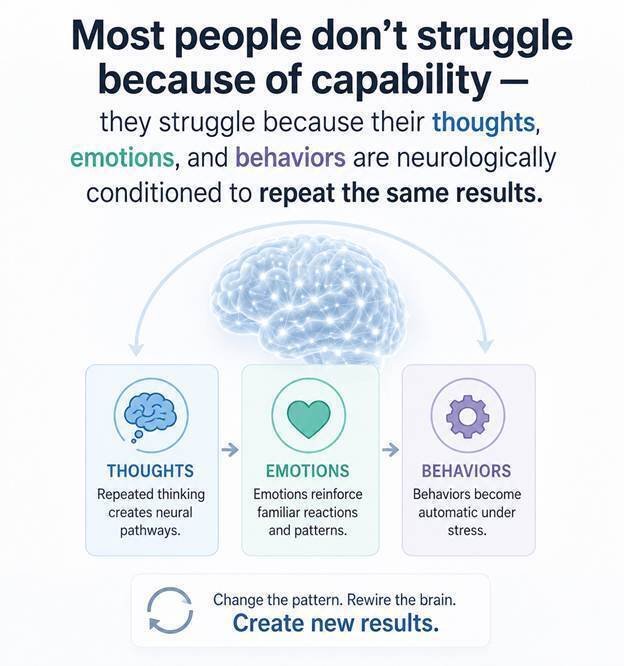
Most people don't struggle because of capability—they struggle because their thoughts, emotions, and behaviors are neurologically conditioned to repeat the same results.
Through Change Your Mind. Create New Results.™, I help leaders interrupt stress-driven conditioning, regulate themselves under pressure, and create cultures driven by intention instead of survival.

Change the Pattern. Change the Result.
Unbelievable Coach — Change That Sticks.
Ready to Create Different Results?
If you're exhausted by pressure, stress, emotional reactivity, or repeating the same leadership patterns, maybe it's time to stop managing symptoms and start changing the conditioning that drives them.
Real change begins when leaders learn how to regulate themselves under pressure—because regulated leaders create healthier cultures, clearer communication, and stronger performance.
If you want to create a different future for yourself and your organization, let's start the conversation.
Schedule your complimentary 30-minute Leadership Conversation today:
https://unbelievablecoach.com/contact/
Because lasting transformation doesn't happen by accident.
It happens one repeated choice at a time.
Schedule a Strategic Conversation
https://meetme.so/DouglasAWick
Visit: Unbelievable Coach
NEXT BLOG - A Leader’s Stress Never Stays With the Leader 
Topics: stress, Change Your Culture, Neuro Change Solutions, Change Your Mind Create New Results, Neuroscience, Handling Stress, Inner Transformation



.jpeg?width=150&height=135&name=Hand%20with%20marker%20writing%20the%20question%20Whats%20Next_%20(1).jpeg "Schedule a meeting")